The document identifies 19 Catalan fashion brands that have sustainable business models
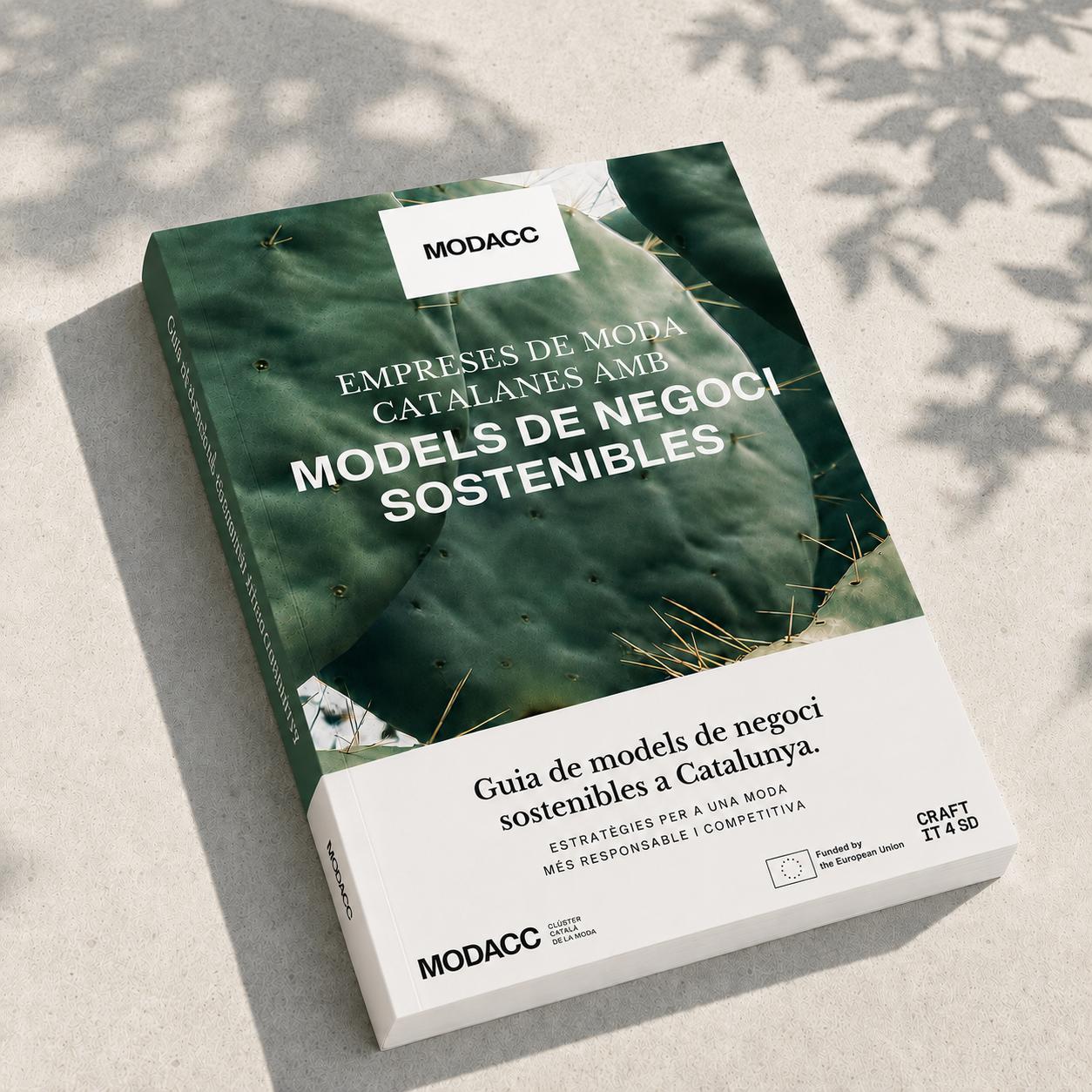
MODACC, as part of the CRAFT-IT 4SD project, has published the Guide to Catalan fashion companies with sustainable business models, a new sectoral directory that gives visibility to brands and companies that are promoting more sustainable, circular and environmentally responsible business models.
The publication was born with the desire to become a reference document for the sector and focuses on companies that incorporate strategies aligned with the major environmental, social and regulatory challenges currently facing the textile and fashion industry.
As part of the project, MODACC has carried out a mapping of the main sustainable business models applicable to the fashion sector, identifying six major categories: extension of the useful life of the product; shared use; recirculation of materials; circular design and production; production on demand; and social impact. To be part of the guide, companies must be implementing one of six sustainable business models identified by academic researchers.
These models include initiatives such as repair, resale and reconditioning of parts; rental or sharing systems; recycling and upcycling; ecodesign and recyclability; production on demand to reduce surpluses; as well as projects linked to employment, the social economy and inclusion.
The guide includes a total of 19 Catalan companies, 75% of which are companies associated with MODACC.
The document also contemplates a qualitative investigation promoted by MODACC to analyze the perception of the Catalan fashion ecosystem on sustainable business models, identifying their main drivers, implementation barriers and the perception of their environmental, economic and social impact.
The study concludes that sustainable business models in the Catalan fashion sector present a high degree of diversity and reflect an active, innovative ecosystem with the ability to adapt to the sustainability challenges facing the industry. However, the development of the different models is not homogeneous.
Currently, initiatives focused on product optimization - such as the use of sustainable materials, eco-design or responsible production - predominate, while models that involve a deeper transformation of the business remain in the minority.
In this context, the research highlights a clear strategic opportunity for the sector: to evolve from traditional models focused exclusively on product sales towards hybrid models that integrate services, extend the useful life of parts and allow value to be captured throughout their entire life cycle, without the use of new resources.
With this initiative, MODACC reinforces its role as a driving agent for the sustainable transformation of the sector and consolidates a living and reference tool to continue promoting the circularity and competitiveness of Catalan fashion.
Thus, it is a guide that contemplates the integration of new companies. If a fashion brand in Catalonia carries out sustainable practices and wants to be part of it, it should contact the Cluster at info@modacc.cat
The guide can be consulted through the following link: https://modacc.cat/filemanager/media-resource/download/582/






 GUIA_Empreses de moda catalanes amb models de negoci sostenibles -
PDF (56369 KB )
GUIA_Empreses de moda catalanes amb models de negoci sostenibles -
PDF (56369 KB )